
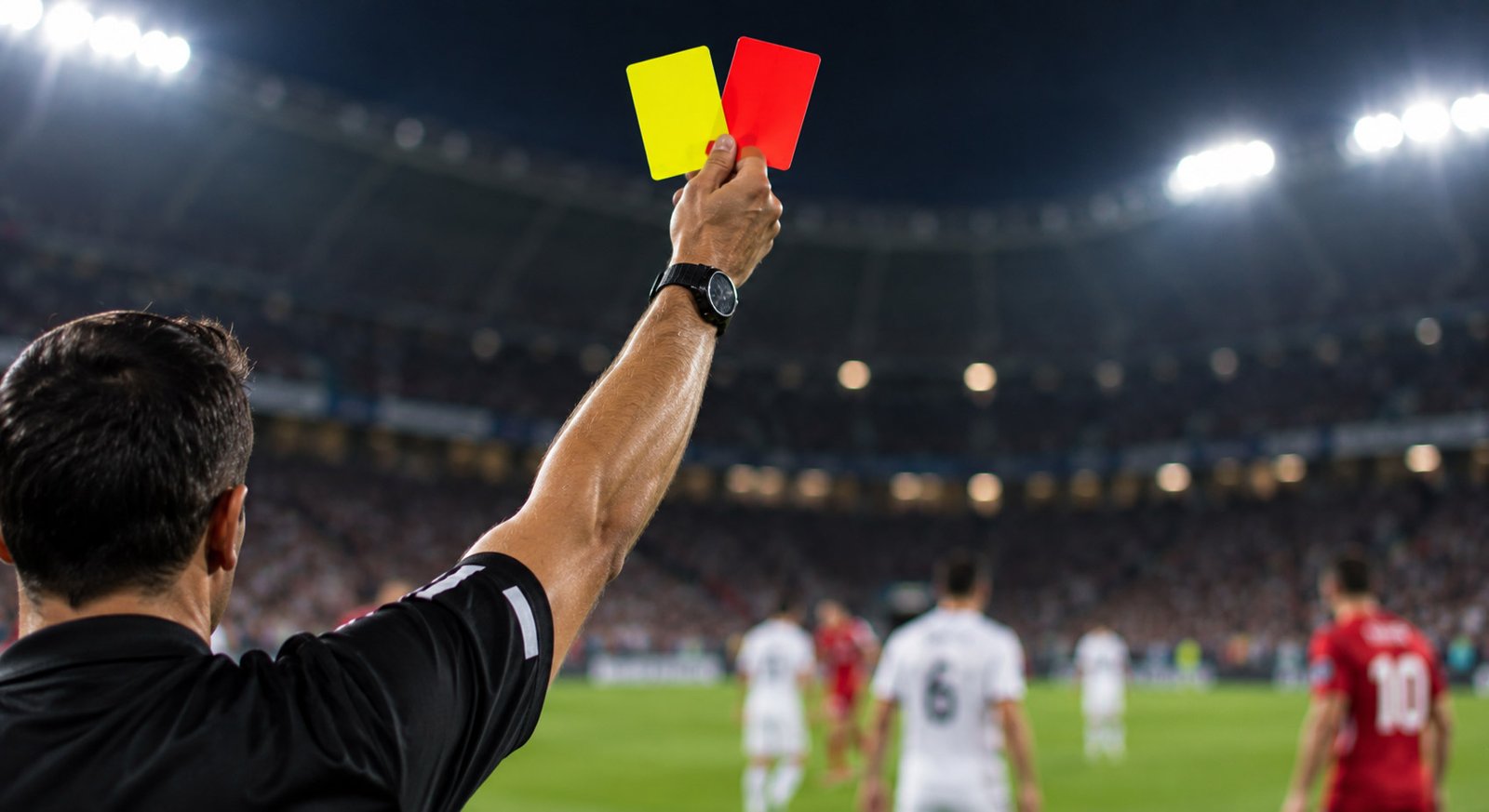
Yellow and Red Cards Explained: 5 Proven Facts You Need
Here’s the short version if you’re pressed for time: Yellow and Red Cards trace back to a traffic light. English referee Ken Aston came up with the visual idea after the confusion that followed the 1966 World Cup quarter-final between England and Argentina, and the system was officially introduced at the 1970 World Cup in Mexico. It’s stayed remarkably close to its original form ever since. Below, we cover where the system actually came from, how the rules work today, and a few details — including recent VAR changes — that surprise even longtime fans.
History of Yellow and Red Cards in Football: The Traffic Light Story
The history of yellow and red cards in football starts with a referee named Ken Aston, and a genuinely chaotic match. Before cards existed, referees communicated cautions and send-offs verbally, and language differences between officials and players could make that process genuinely confusing in international football.
That problem came to a head at the 1966 World Cup quarter-final between England and Argentina at Wembley, where German referee Rudolf Kreitlein sent off Argentina’s captain, Antonio Rattín. Because Kreitlein didn’t speak Spanish and Rattín didn’t speak German, the dismissal turned into a lengthy on-pitch standoff, with Rattín refusing to leave for several minutes while confusion spread through the stadium.
The story goes that sometime after the match, Aston stopped at a set of traffic lights on Kensington High Street and had his moment of inspiration: yellow for “take it easy,” red for “stop, you’re off.” According to FIFA’s own account of the story, Aston even had his wife cut prototype cards out of construction paper to show the idea off.
FIFA loved it, and Yellow and Red Cards made their official debut at the 1970 World Cup in Mexico — though in a quirky footnote, no red card was actually shown during that entire tournament, despite yellow cards seeing plenty of use. The first World Cup red card wouldn’t come until 1974, when Chile’s Carlos Caszely was sent off against West Germany.
Football Card Rules: How Cautions and Send-Offs Actually Work
Once you get past the origin story, the football card rules themselves are fairly straightforward, though a couple of details are more nuanced than they first appear. A yellow card is a formal caution — a warning that a player’s conduct has crossed a line, whether that’s a reckless tackle, dissent toward the referee, or persistent fouling. Two yellow cards in the same match automatically result in a red, and the player is sent off.
A direct red card, shown for more serious offences like violent conduct, results in immediate ejection with no second chance — the player leaves the pitch and their team plays the rest of the match a player short.
Denying an obvious goal-scoring opportunity (DOGSO) is one of those offences that catches people out, because it doesn’t automatically mean a red card in every situation. Outside the penalty area, a DOGSO offence will normally result in a red card.
Inside the box, though, an IFAB rule change from 2016 means that if a defender is genuinely attempting to play the ball — a real challenge for it, rather than holding, pulling, or pushing an attacker — the sanction typically drops to a yellow card, with the penalty kick itself treated as sufficient punishment. Fouls with no genuine attempt to play the ball, or a deliberate handball that denies a goal, still result in a red card regardless of where they happen.
What trips a lot of casual fans up is that yellow cards don’t just vanish once the final whistle blows. Many tournaments apply accumulation rules that carry a yellow card forward into later matches, with enough cautions within a set window triggering an automatic suspension — but the exact threshold, and when cards get wiped clean, varies from competition to competition rather than following one universal rule.
It’s exactly the kind of detail that can quietly reshape a team’s lineup heading into a crucial knockout match. If you’ve followed how a card decision can swing an entire game, our recap of England’s Round of 16 win over Mexico, where England had to survive a red card, shows just how much a single dismissal can change a match’s entire complexion.
How VAR Changed the Way Cards Get Shown
Card decisions used to rest entirely on what the referee saw in real time, which occasionally meant serious incidents got missed or soft ones got overcalled. That’s changed with the introduction of video review — our breakdown of how VAR actually works covers this in more detail.
The short version relevant to cards is this: under the current VAR protocol, referees can already have direct red-card incidents like serious foul play and violent conduct reviewed. More recently, that scope has expanded to cover red cards resulting from a clearly incorrect second yellow card, as well as cases of mistaken identity, where the wrong player was shown a card for an offence committed by someone else.
It’s worth being precise about what that second point actually covers, since it caused genuine debate during the 2026 World Cup — most notably when Switzerland’s Breel Embolo was sent off against Argentina in the quarter-finals after a second-yellow review that IFAB later clarified shouldn’t have applied to that situation.
The episode highlighted the limits of the rule: mistaken identity review can correct who was booked, but it can’t reopen or change the offence itself unless that offence separately qualifies for review. VAR still can’t simply flag that a referee missed a second bookable offence altogether — it only steps in once a card has actually been shown incorrectly.
Why the Yellow and Red Card System Has Lasted So Long
Part of what makes this such a durable piece of football history is just how well the original idea has aged. The core signal — yellow for caution, red for dismissal — hasn’t needed to change since 1970, even as the disciplinary rules around it have grown more detailed over the decades.
If you’re curious about other foundational football rules that shape how a match unfolds, our guides on the offside rule and why football has stoppage time cover two more rules that, like cards, look simple on the surface but carry a surprising amount of nuance underneath.
The Bottom Line
Yellow and Red Cards are one of those rare sporting inventions that solved a real problem so cleanly that almost nothing about the core idea has needed to change since 1970. A traffic light inspired Ken Aston’s idea, and the result was a visual language that works in every stadium, in every country, regardless of what language the players and officials speak — and more than 50 years later, that’s still exactly why the system works.





















Leave A Comment