
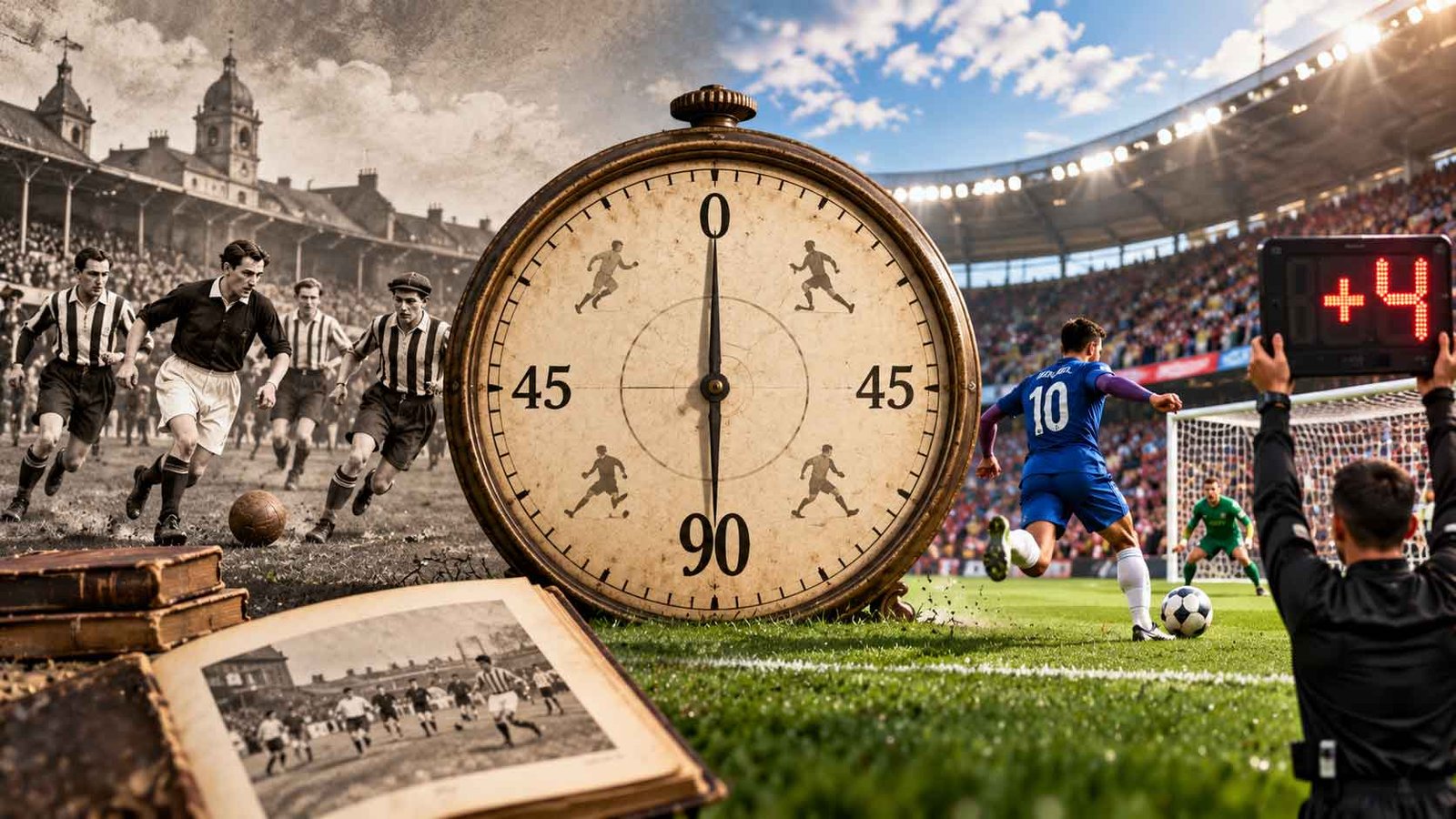
Why Is Football 90 Minutes Long? The Fascinating History Behind the Rule
The Short Answer: Why Is Football 90 Minutes Long?
Football 90 minutes is the standard match length today, but it was not always the rule in the early days of the sport. Football developed over many years, and different clubs once followed different playing arrangements. As the game became more organised, its rules gradually moved towards a common standard.
A standard senior football match now consists of two 45-minute halves, with a half-time interval in between. However, football 90 minutes does not mean every match must end exactly when the clock reaches 90:00. Referees can add time for interruptions, while some knockout competitions use extra time if a winner must be decided.
There is no reliable evidence that one person selected 90 minutes for a single, universally accepted reason. The more accurate explanation is that the format developed over time and eventually became part of the official rules.
1. Football Did Not Always Have a Fixed Match Length
In the 19th century, football was still developing into the organised sport we recognise today. Before common rules became widely accepted, schools and clubs could follow different local traditions. As a result, match length was not always consistent.
The Football Association was formed in England in 1863 to help establish a shared set of rules. This was an important step towards modern football, but it did not immediately make every aspect of the game uniform.
Historical accounts of early matches show that playing times varied. Some games lasted around an hour and a half, while others followed different arrangements. These examples suggest that football 90 minutes appeared relatively early in the sport’s history, but it was not instantly a universal requirement.
Understanding this background helps explain why football 90 minutes became a standard gradually rather than through one sudden decision.
For more background on the development of the sport, read FIFA’s overview of football history and the Laws of the Game.
2. When Did Football 90 Minutes Become an Official Rule?
The history of football 90 minutes is a gradual story, rather than a decision made on one particular day.
The International Football Association Board (IFAB) was founded in 1886 to oversee and develop the Laws of the Game. As football became more organised, the need for consistent rules became increasingly important for clubs, referees and competitions.
The 1897 edition of the Laws of the Game explicitly stated that a match should last 90 minutes unless both sides agreed otherwise. This is an important historical milestone because it provides documentary evidence that the 90-minute duration had been written into the rules by that time.
It is important to distinguish between early matches that happened to last around 90 minutes and a rule that formally specified that duration. Football 90 minutes became an established standard through the gradual development of the sport’s official regulations.
Today, IFAB Law 7 states that a standard match consists of two equal halves of 45 minutes. Shorter halves may be allowed if the referee and both teams agree before the match and the competition regulations permit it.
You can check the current wording in the official IFAB Law 7: The Duration of the Match.
3. Football Match Duration: Why Two Halves of 45 Minutes?
The standard football match duration is 90 minutes, divided into two 45-minute halves. This structure creates a clear playing period before and after half-time, making matches easier to organise and follow.
There is no need to claim that 45 minutes was chosen because it is a perfect scientific measure. The historical record supports a simpler explanation: football developed through shared conventions, and the 90-minute format eventually became part of the standard rules.
The half-time interval gives players an opportunity to rest, drink water and receive tactical instructions from their coaches. Under the standard IFAB rules, half-time must not exceed 15 minutes, although competition regulations determine the arrangements that apply to a particular match.
For fans, the format creates a familiar rhythm: the first half, half-time and the second half. Whether you watch a local match in Malaysia or an international tournament, the standard structure is broadly the same.
When people ask why football 90 minutes became the norm, the two 45-minute halves are the clearest part of the answer. They form the standard match structure recognised by the Laws of the Game.
4. Why Can Football Matches Last Longer Than 90 Minutes?
Although football 90 minutes is the standard playing time, the final whistle may come after the clock passes the 90-minute mark. This is because the referee allows added time, also commonly called stoppage time, to account for certain delays during each half.
Under IFAB Law 7, these delays can include:
- Substitutions
- Assessing or removing injured players
- Time-wasting
- Disciplinary incidents
- VAR checks and reviews
- Goal celebrations
- Other significant delays to restarting play
The fourth official displays the minimum additional time decided by the referee. The referee can increase that amount but cannot reduce it.
Added time is not a separate bonus period. It is intended to account for time lost during the half. That is why a match can continue to the 93rd or 98th minute without entering extra time.
So, football 90 minutes describes normal playing time, not necessarily the exact moment when the final whistle must sound. The amount of added time depends on what happens during the match.
For a more detailed explanation, read our guide to why football has stoppage time.
5. Is Extra Time the Same as Added Time?
No. Added time and extra time are different parts of football rules.
Added time is played at the end of each half to account for delays during that period. It is part of the normal football 90 minutes.
Extra time may be used in a knockout competition when the rules require a winner and the score is level after normal time. Under the usual format, extra time consists of two 15-minute periods, subject to the competition’s regulations. If the teams remain level, a penalty shootout may follow.
Not every drawn match goes to extra time. In a league match, a draw is usually an accepted result. In a cup competition, the regulations may specify extra time, penalties or another method of deciding the winner.
This distinction is useful for fans because a match that continues beyond 90 minutes is not necessarily in extra time. It may simply be completing its added time.
Knowing the difference between normal time, added time and extra time makes football rules easier to understand.
6. Do All Football Matches Last 90 Minutes?
No. The standard 90-minute format mainly applies to senior association football played under the usual Laws of the Game. Other formats and age groups may use different match lengths.
For example, youth competitions may have shorter halves to suit the players’ age, development and competition requirements. Futsal also follows its own playing-time rules, so it should not be treated as identical to a standard outdoor football match.
Even in a standard match, the referee may need to allow added time. Competitions that must produce a winner may also have specific procedures for extra time or penalties.
This means football 90 minutes is the normal standard for a typical senior match, not a guarantee that every game in every format will last exactly 90 minutes from kick-off to the final whistle.
The competition rules always matter, especially when comparing league fixtures, cup matches, youth football and futsal.
7. Why the 90-Minute Format Still Works Today
The familiar 90-minute structure gives football a consistent framework. Players know how the match is organised, coaches can plan their tactics around two halves, and fans understand the basic rhythm of the game.
The format also allows teams to adjust at half-time. A coach may change the formation, replace a tired player or give instructions based on what happened in the first half. The second half then becomes an opportunity to respond.
At the same time, added time allows referees to account for significant interruptions instead of treating every second on the clock as uninterrupted playing time. This helps explain why football 90 minutes remains the standard while the actual finish time can vary.
The system is familiar, but it is not simply a countdown that ends automatically at 90:00. It operates according to the Laws of the Game and the events that take place during a match.
Conclusion: A Tradition That Became a Standard
Football 90 minutes became the standard through the gradual development and formalisation of football rules. Early matches did not always follow one universal duration, but the 90-minute format eventually became the accepted structure for a standard senior match.
Today, the usual football match duration is two 45-minute halves, with added time to account for interruptions. Extra time is different and is only used when the competition rules require it.
The next time a referee signals several minutes of added time, remember that football 90 minutes is not simply a stopwatch counting down. It is a format shaped by the sport’s history, official rules and the need to account fairly for interruptions during play.

















Leave A Comment